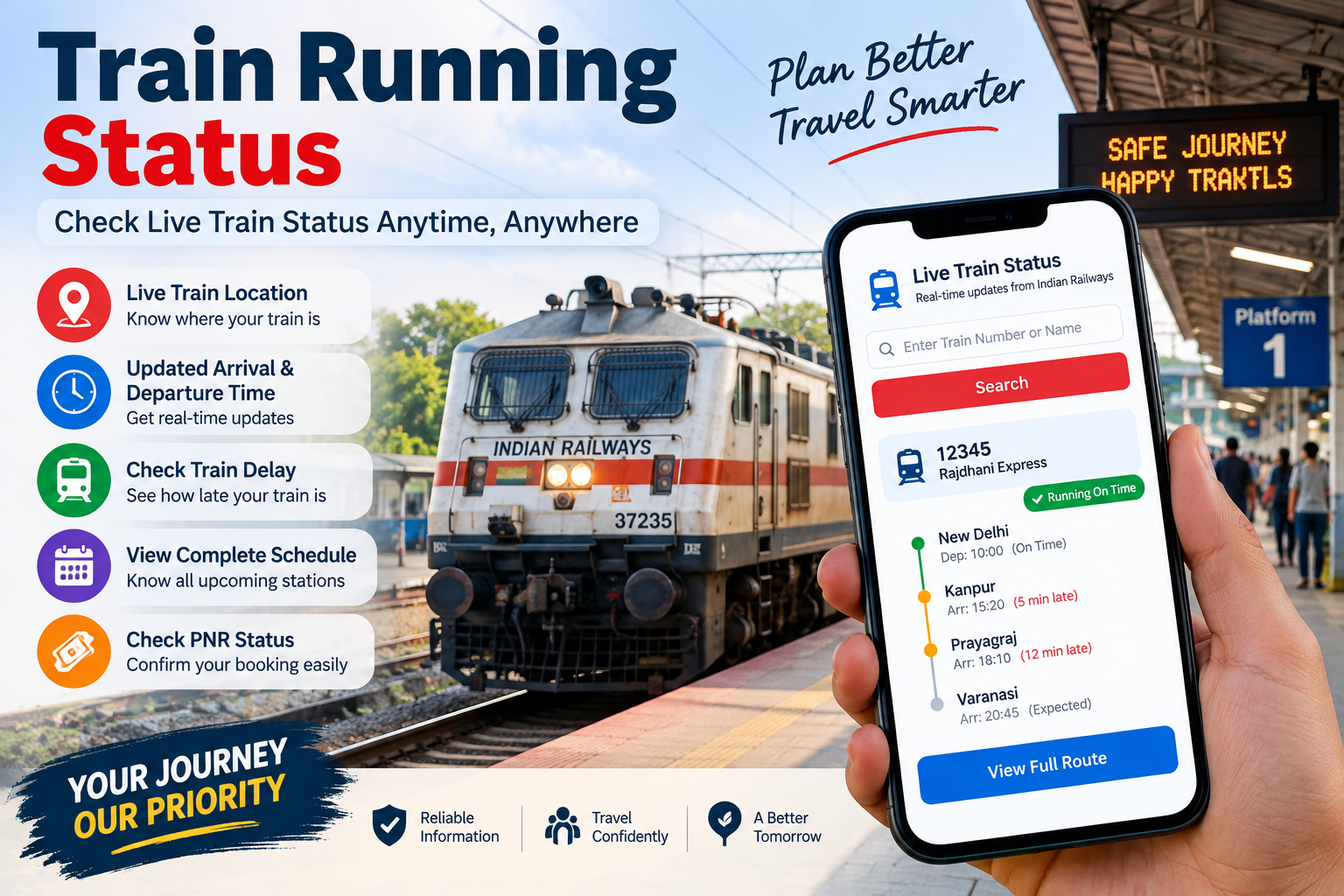
When you are travelling by train, knowing the train running status can save you from unnecessary waiting at the station. A train may leave its starting station on time but reach your boarding station late because of congestion, operational changes, weather, maintenance work, or delays earlier on its route. Checking the live running position before leaving home gives you a much better idea of what is happening.
For Indian Railways passengers, live train information can be checked through official railway enquiry services. Indian Railways provides online services for train status, schedules, PNR information, seat availability, and related enquiries. Its railway enquiry system is operated by the Centre for Railway Information Systems (CRIS).
This guide explains how to check train running status online, what information you need, how to understand delay information, the difference between train status and PNR status, and what you should check before leaving for the station.
What Is Train Running Status?
Train running status tells you where a particular train is currently running in relation to its scheduled journey.
Depending on the available railway data, the status can help you determine:
- Whether the train has started its journey
- The station it has most recently passed
- Its current or latest reported location
- Whether it is running on time
- How much delay it is experiencing
- Its expected arrival at upcoming stations
- Its expected departure from upcoming stations
- Whether the train has reached its destination
The important distinction is between the scheduled timetable and the live running position.
A timetable tells you when a train is supposed to arrive. Running status tells you what is happening during the actual journey.
Indian Railways also provides a separate train-schedule enquiry where users can enter a train number or train name to view scheduled stations, arrival times, departure times, halts, distance and running days.
How to Check Train Running Status Online
The easiest approach is to use an official Indian Railways enquiry service.
Step 1: Find your train number
Your train number is usually printed on your ticket or booking information.
If you know only the train name, the official railway enquiry system also allows train information to be searched using the train name or some digits of the train number.
Step 2: Check the journey date
The journey date is important because the same train number can operate on different dates according to its timetable.
For live status, make sure you select the appropriate source/journey date rather than simply entering today’s date without checking your ticket.
Step 3: Open the official railway enquiry service
The Indian Railways enquiry website provides passenger and train-related services, including train schedules and status-related information.
You can use the official Indian Railways website:
Indian Railways Passenger Enquiry
For ticket-related current status, Indian Railways also provides its official passenger enquiry service.
Step 4: Enter the required train information
Depending on the service you use, you may need the train number and journey/source date.
Indian Railways’ internal railway systems also document a Train Status Enquiry function in which the train number and source date are used to retrieve the current train status.
Step 5: Review the latest information
Once the enquiry is processed, look at:
- Last reported station
- Actual arrival
- Actual departure
- Scheduled arrival
- Scheduled departure
- Delay
- Upcoming station information
Use the latest available update rather than relying on an old screenshot or message forwarded by someone else.
Train Running Status vs Train Schedule
These two terms are often confused.
Train Schedule
A train schedule is the planned timetable. It tells you when the train is scheduled to reach each station.
For example:
| Information | Example |
|---|---|
| Train number | 12345 |
| Station | Kolkata |
| Scheduled arrival | 08:30 AM |
| Scheduled departure | 08:35 AM |
| Halt | 5 minutes |
This is planned information.
Train Running Status
Running status reflects the train’s actual journey.
For example:
| Information | Example |
|---|---|
| Station | Kolkata |
| Scheduled arrival | 08:30 AM |
| Actual arrival | 08:47 AM |
| Delay | 17 minutes |
| Next station | Bardhaman |
The train schedule tells you what should happen. Running status helps you understand what is happening.
Indian Railways separately provides a train schedule enquiry that includes station names, arrival and departure times, halt duration, distance and route day.
Why Should You Check Live Train Status?
Checking the status before leaving for the station is useful for several reasons.
Avoid unnecessary waiting
If your train is running significantly late, you may be able to adjust when you leave home, depending on your circumstances and station access.
Plan your journey to the station
Knowing the expected train arrival can help you coordinate a taxi, bus, metro, auto-rickshaw, or private vehicle.
Check long-distance journeys
For overnight or long-distance trains, a delay at an earlier station can affect your arrival time much later in the journey.
Plan onward transportation
If someone is picking you up at your destination, an updated running status can help them plan.
Stay informed about disruptions
When a train is delayed, cancelled, diverted, or otherwise affected, passengers should rely on official railway information rather than an old timetable.
What Does “Running Late” Mean?
When a train is shown as running late, the displayed delay generally represents the difference between its scheduled movement and its reported actual movement.
For example:
Scheduled arrival: 6:00 PM
Expected arrival: 6:45 PM
Delay: 45 minutes
That does not necessarily mean the train will remain exactly 45 minutes late for the rest of the journey.
A train can recover some time later, or its delay can increase because of another operational issue.
For this reason, if your journey is still several hours away, checking the status again closer to your departure from home is sensible.
How Accurate Is Train Running Status?
Live railway information is useful, but it should not be treated as a guarantee that a train will arrive at precisely the displayed minute.
Railway operations are dynamic. A train can encounter changes after the last status update.
For important journeys, especially when you have an onward flight, bus, examination, appointment, or other time-sensitive commitment, allow sufficient buffer time.
Also remember that scheduled time and live estimate are different pieces of information.
What Is the Difference Between Train Status and PNR Status?
This is one of the most important distinctions for railway passengers.
Train Running Status
This tells you about the train’s journey.
It answers questions such as:
- Where is the train?
- Is it delayed?
- When might it reach my station?
- Has it departed from a particular station?
PNR Status
PNR status relates to your ticket reservation.
It answers questions such as:
- Is my seat confirmed?
- Am I on RAC?
- Am I on the waiting list?
- What is my coach and berth status?
Indian Railways’ official passenger enquiry service displays booking status, current status, charting status and train-status information. It also lists common codes such as CNF, RAC and various waiting-list categories.
So, if you want to know where the train is, check running status.
If you want to know whether your ticket is confirmed, check PNR status.
How to Check PNR Status
If your concern is your ticket rather than the train’s location, use the official Indian Railways passenger enquiry service.
Check PNR Status on Indian Railways
You will need the PNR number printed on your ticket.
The official enquiry page states that the PNR can be used to retrieve booking and current passenger status. It also notes that current status can change before the final chart is prepared.
Understanding Common Train Status Information
The exact wording can vary depending on the service, but several types of information are particularly useful.
On Time
The train is broadly following its scheduled timing.
Even when a train is displayed as on time, check again if your boarding time is still some distance away.
Delayed
The train is behind its scheduled movement.
Look at the expected arrival or departure rather than only the total delay number.
Arrived
The train has reached the reported station.
If it has arrived at your boarding station, you should pay attention to the departure information as well.
Departed
The train has left the reported station.
If you are boarding at a later station, check the next station and expected timing.
Not Started
The train has not yet begun its journey from the relevant origin.
This does not necessarily mean that the train is cancelled.
Cancelled
If official railway information shows that the train is cancelled, do not assume that a normal running-status delay will resolve the problem.
Check the official railway notification and your ticket/refund information where applicable.
How to Check Train Schedule
Sometimes you do not need live tracking at all. You may simply want to know when the train normally reaches a station.
Indian Railways provides a Train Schedule enquiry service. You can search using the train number or train name. The official service displays information such as:
- Train number
- Train name
- Days on which it runs
- Station sequence
- Arrival time
- Departure time
- Halt time
- Distance
- Route day
Indian Railways Train Schedule Enquiry
This is useful when planning a trip before the journey date.
How to Check Train Running Status on Mobile
You can check railway information from a smartphone using official railway services.
A mobile phone is particularly convenient because you can check the status shortly before leaving for the station.
IRCTC’s official Rail Connect documentation also includes functions for viewing current ticket status, while Indian Railways provides separate enquiry services for train information.
For safety, download railway apps only from official app stores and verify that the publisher is legitimate. IRCTC’s own materials warn users to use official Rail Connect applications and to be cautious of fraudsters.
Train Running Status for Connecting Journeys
Suppose your train is scheduled to reach Delhi at 4:00 PM and you have another train at 6:00 PM.
A simple timetable check may not be enough.
If your first train is currently running two hours late, you need to consider the possibility that the connection will become difficult.
The same principle applies to:
- Train-to-flight connections
- Train-to-bus connections
- Hotel check-in
- Airport transfers
- Work appointments
- Exams
- Medical appointments
- Events
In such cases, running status is useful for planning, but it cannot guarantee an exact future arrival.
What Should You Check Before Leaving for the Station?
A quick pre-journey checklist can prevent avoidable problems.
Check 1: Train number
Make sure you are tracking the correct train.
Check 2: Journey date
Confirm that the date corresponds to your actual journey.
Check 3: Boarding station
Do not confuse your boarding station with the train’s origin station.
Check 4: Live running status
Check the latest reported movement.
Check 5: Expected arrival
Look at the expected time at your boarding station.
Check 6: Platform information
Where available, check official station/platform information separately. Do not assume that the platform number from an old message is still valid.
IRCTC’s eCatering service specifically advises passengers to check the latest train running status, platform information and coach position before commencing their journey.
Why Train Status Can Change After You Check It
A train’s running position is not a fixed appointment.
For example, imagine:
10:00 AM: Train is 30 minutes late.
12:00 PM: Delay reduces to 20 minutes.
3:00 PM: Train becomes 40 minutes late again.
This can happen because the railway network is continuously operating. Congestion, crossing arrangements, operational decisions, speed restrictions, weather and other factors can affect movement.
Therefore, a status checked several hours ago should not be treated as the latest information.
Is Train Running Status the Same as Coach Position?
No.
Running status tells you about the train’s movement.
Coach position tells you where particular coaches are arranged in the train formation and can help passengers locate their coach at the station.
They are different types of information.
For example:
- Running status: Train is 25 minutes late.
- Coach position: Your B2 coach is located toward a particular section of the platform.
Both can be useful immediately before boarding.
Official Sources Are Better for Time-Sensitive Information
Train information changes quickly. For that reason, an article explaining how to check train status should not pretend that a static webpage can provide a train’s live location indefinitely.
For current information, use the official railway enquiry system.
The Indian Railways website provides passenger enquiry services and identifies CRIS as the organisation responsible for the site’s design/hosting in the relevant service pages.
If you are using an unofficial app or website for convenience, compare important information against an official railway source before making a time-sensitive decision.
Common Mistakes When Checking Train Status
Searching only by train name
Train names can sometimes be similar. Using the correct train number is generally more precise.
Forgetting the journey date
The date matters, particularly for trains that run on selected days.
Confusing PNR status with running status
Your confirmed ticket does not tell you where the train currently is.
Checking too early
A status checked many hours before departure may change.
Trusting old screenshots
A screenshot shows what was displayed at one moment, not what is happening now.
Relying on unofficial claims
For cancellations, major delays or other disruptions, verify information with an official railway source.
Conclusion
Checking train running status is one of the simplest ways to make a railway journey more predictable. Instead of relying entirely on the scheduled timetable, you can check the latest available movement information and understand whether your train is on time, delayed, already departed, or approaching your station.
The most important thing is to use the correct information for the question you are asking. Running status tells you about the train’s movement. PNR status tells you about your reservation. Train schedule tells you the planned timetable. Coach position helps you locate your coach at the station.